
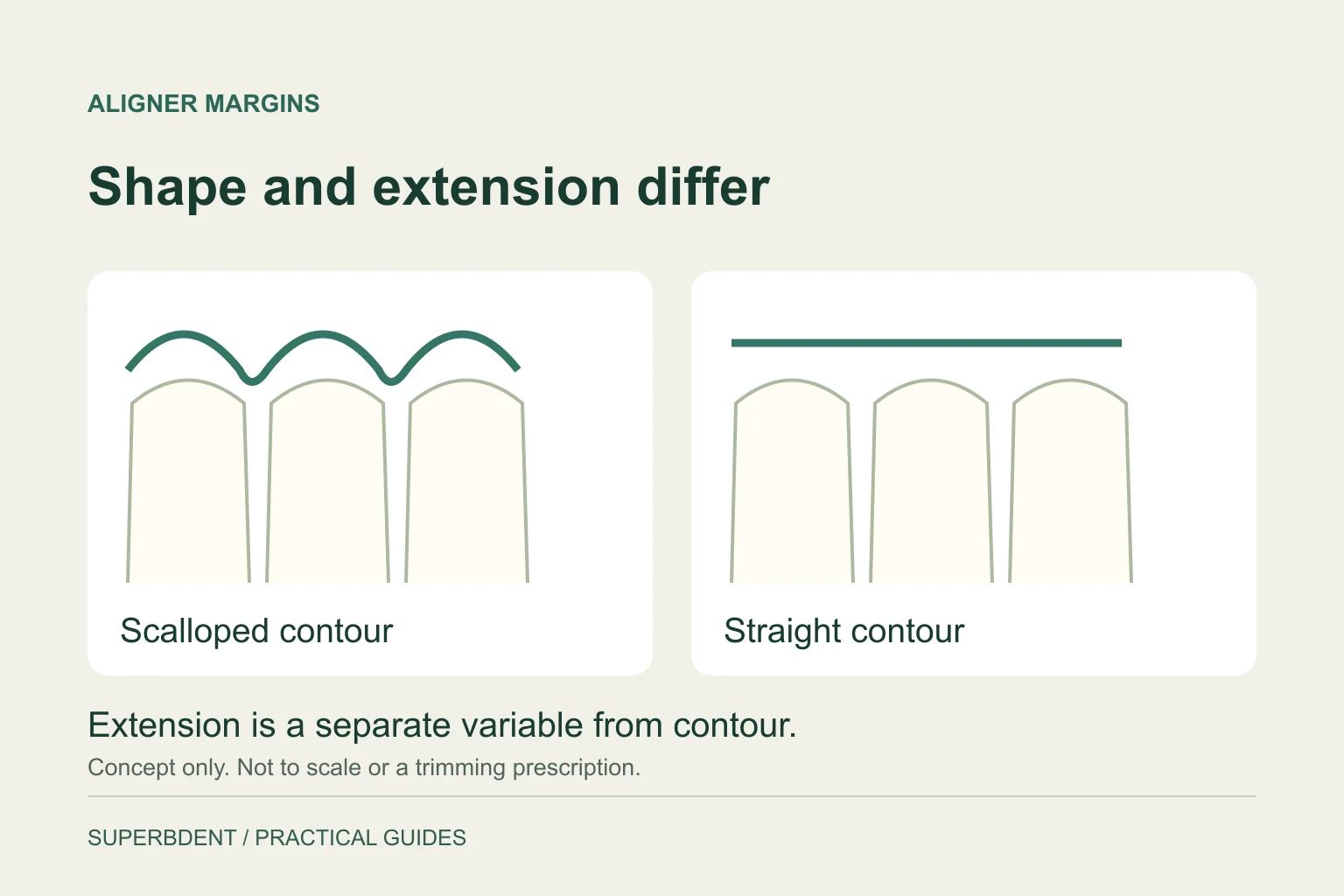
A scalloped aligner margin follows a curved contour around the teeth, while a straight margin has a more continuous outline. That describes shape. How far the plastic extends relative to the gingival margin is a second variable. Comparing “scalloped” with “straight” without discussing extension, material, and the intended movement leaves important design information out.
Separate shape, extension, and finishing
| Design detail | Question to settle with the lab |
|---|---|
| Contour | Is the margin scalloped, straight, or locally modified? |
| Extension | What reference is used to describe its height, and does it vary by region? |
| Material and manufacture | Which material and fabrication process are being compared? |
| Treatment features | How are attachments and other prescribed features incorporated? |
| Edge finishing | What does the lab check, and how are edge concerns reported? |
What two primary studies actually tested
A 2022 in-vitro study by Elshazly and colleagues tested 36 aligners made from 0.75 mm Zendura FLX sheets. It compared four combinations of contour and extension and measured force transmission around an upper central incisor. In that setup, the straight extended design produced the highest measured forces, while the scalloped design produced the lowest. The experiment measured appliance mechanics, not treatment duration or patient comfort. Two coauthors listed an affiliation with Institut Straumann.
A second laboratory study by Traversa and colleagues, published online in 2024 and in a 2025 journal issue, tested 30 aligners with two flat trimline heights. It examined an incisor, canine, and molar during three translational movements. Responses varied with tooth position, movement, and trimline height, including reactions at neighboring teeth. The authors called for clinical confirmation. Two authors listed an affiliation with Institut Straumann, a manufacturer in this field.
| Observation | What it does not establish |
|---|---|
| Changing the edge can change measured forces and moments. | That a larger force always produces a better clinical result. |
| Different teeth and movements respond differently in a test setup. | That one margin design is optimal throughout every patient’s treatment. |
| A study uses a named material and defined geometry. | That the findings transfer unchanged to another material, manufacturing method, or anatomy. |
| A design performs differently on a bench model. | How it will feel, fit, or perform over a complete course of patient care. |
Use evidence to sharpen the specification
When reviewing a lab’s proposal, ask which variables differ from your current system. A new material, different attachments, revised staging, and a changed trimline introduced together cannot be interpreted as a clean comparison of the edge alone. Request the design description in terms that both the clinical team and lab understand.
For a proposed change, record the intended purpose, the cases it applies to, who approves it, and what information the practice will send back. The useful question is not “Which edge wins?” but “What is this design intended to do in this treatment system, and how will we evaluate the patient’s response?”
Keep fit feedback specific
- Identify the case, arch, stage, and exact region of the concern.
- Distinguish a sharp-feeling edge, a visible seating gap, and difficulty inserting or removing the tray.
- Send the requested records through the agreed practice-to-lab channel.
- Ask whether the concern needs clinical reassessment, a manufacturing review, or another documented action.
A trimline article is not an instruction for patients to cut or reshape aligners. Alteration can change the design being discussed. Patients with irritation or a fit change should contact their treating practice; the tracking guide helps them describe the observation.
When comparing laboratories
Ask for a sample of the written specification and the process for resolving edge or fit concerns. Keep the evidence question separate from the fee question: an attractive package does not establish equivalence between systems. Our lab-switching checklist and refinement questions help document the broader arrangement.
Sources & further reading
- Elshazly et al. (2022): trimline design and edge extension, in-vitro study
- Traversa et al. (2025; online 2024): tooth position and flat trimline height, laboratory study
Prepared by SuperbDent Editorial. General education; your treating clinician determines your appliance and care plan.